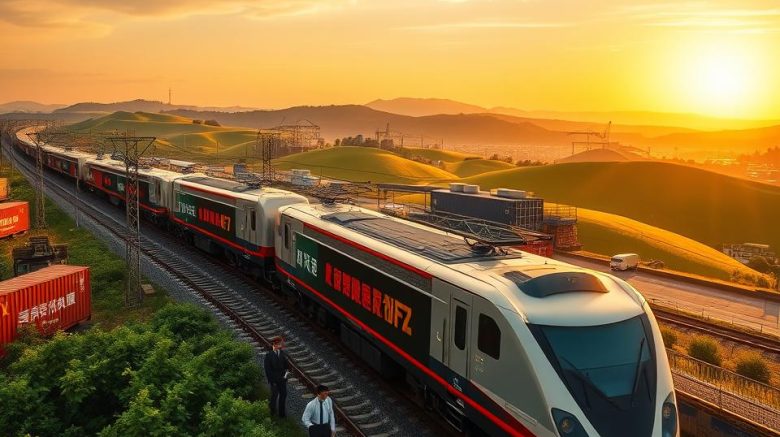
China–Europe Railway Express: Improving Global Trade Routes
The China-Europe rail link launched as a single trial in the year 2011 and became a central land-based corridor by 2013. Over a decade it ran approximately 77,000 freight trips and transported freight valued near $340 billion.
U.S. shippers now have wider access to markets across Asia and Europe through a predictable China Europe railway express train network. This land route shortens lead times and improves timetable confidence compared with sea-only transport.
Goods range from mechanical and electrical products to perishable food, with clear origin and product information that helps buyers trust imports. The route network links 130+ cities in 25+ countries and logged over 10,500 trips in the first eight months of 2023, showing steady growth.
For procurement and logistics teams this rail option is a useful complement to maritime lanes. It offers a hybrid strategy that balances cost, speed, and risk while expanding market access for mid-sized exporters.
Key Takeaways
- Built fast: the network grew from one monthly run to dozens each week, supporting consistent growth.
- Dependable transit: scheduled trains cut lead-time variability compared with ocean shipping.
- Varied cargo: machinery, components, and food move with transparent import details.
- Extensive footprint: over 130 connected cities across many countries expand access for U.S. companies.
- Hybrid strategy: rail complements sea lanes, providing planners with more routing choices.
Industry brief: A decade of expansion positions the rail link as a global trade pillar
A decade on from launch, the china-europe railway express has become a stable option for global cargo flows. It marked its 10th anniversary with around 77,000 trains carrying roughly $340 billion in goods.
From pilot services to a high-frequency network: key figures since launch
Early service scaled fast: one monthly departure expanded to 34 runs per week. By 2013 the system registered 8,416 origin runs and shifted millions of tonnes.
| Benchmark | Figure | Impact |
|---|---|---|
| 10-year milestone | ~77,000 trains; ~$340B goods | Highlights sustained scale and commercial reach |
| Jan–Aug 2023 | 10,575 trips (5% up) | Sustained momentum during maritime disruption |
| Initial growth | one a month → 34 weekly | Rapid operational scaling |
BRI context and why it matters for U.S. importers, exporters, and freight forwarders
The belt road initiative provided funding and coordination that accelerated expansion. That support helped add cities, standardise documentation, and improve on-time performance.
“The corridor gives freight forwarders clearer planning windows and better visibility for time-sensitive exports.”
U.S. planners can use China-Europe rail freight to hedge ocean volatility. Forwarders benefit from steadier access, smoother compliance, and dependable transshipment options. Track carrier advisories on the official website to plan bookings around peak demand.
China-Europe railway express: routes, reliability, and performance as supply chains shift
A set of eastern, central, and western corridors now directs bulk freight across the Eurasian landmass with more defined timetables and measurable capacity gains.
The three core corridors
The eastern route links coastal exporters via Manzhouli and onward through Belarus and Poland. The central route supports Guangdong and central provinces via Erenhot. The western corridor moves goods from Xinjiang via Khorgos or Alashankou into Kazakhstan and beyond.
Speed, capacity, and schedule gains
Five pre-timetabled Chongqing-Xinjiang-Europe Railway services span the logistics network, helping shippers schedule pickups and European handoffs with fewer shocks.
In the first half of the year, maximum loads increased to 3,000 tonnes, allowing denser unitization and better dock planning. Typical end-to-end rail transit averages about 12 days versus 35–45 days by sea.
Stabilizing during maritime disruptions
When Red Sea risks pushed vessels around the Cape, land corridors became a strong alternative. Rail often cut transit time and reduced reroute costs compared with longer ocean legs and proved far cheaper than urgent air moves for many product types.
“Scheduled corridors and higher train loads make the route a practical hedge against ocean volatility.”
What moves on the rails
Over 50,000 product types travel via China-Europe freight trains. Mechanical and electrical goods, vehicles, and auto parts lead volumes, while consumer electronics and industrial components support a wide range of service needs.
Poland as a strategic gateway: Warsaw–Zhengzhou service and the growth of a dual-hub model
The new Warsaw–Zhengzhou link formalises a dual-hub model that reduces transit times and simplifies customs handoffs. Poland now handles about 90% of China-Europe railway express traffic, making it a clear European cross-dock for long-haul flows.
Why most trains route through Poland — and what the launch unlocks
Poland’s geography and EU access make it a natural transfer point. Gauge interfaces and established terminals speed up transfers between continental systems. This combination drives high train volumes into Polish hubs.
- Dual-hub advantages: The Warsaw–Zhengzhou pairing speeds door-to-door delivery and streamlines import procedures.
- Distribution reach: Polish terminals offer 24-hour coverage to roughly 90% of nearby countries, helping regional distribution.
- Bidirectional trade mix: autos, parts, dairy, chocolate, and industrial materials move both ways, showing versatile service use.
PKP Cargo Connect and Henan Zhongyu International Port Group underpin the new service, offering steadier capacity and clearer schedules. Increasing train frequency into Poland suggests network maturity and improved alignment for last-mile trucking and customs timing.
“The Warsaw-Zhengzhou service creates practical routes for faster regional fulfillment and fewer empty returns.”
U.S. logistics teams should consider Warsaw a primary consolidation point for multimarket deliveries. Watch operator website notices for capacity releases and retail-season surges to optimise bookings and equipment availability. These steps fit within the belt road framework while focusing on commercial SLAs and predictable operations.
Closing thoughts
Shaped by higher-capacity the Belt and Road Initiative video and clearer schedules, the china-europe railway option now gives U.S. shippers a practical way to diversify transit risk and speed time-to-market.
On average the route cuts transit to about 12 days, making rail the sensible choice when it beats ocean timelines and leaving air for urgent, high-value shipments.
After the 10th anniversary, scheduled services, bigger loads, and improved information flows simplify cross-country planning. Even so, border procedures, equipment imbalances, and subsidy uncertainties require time buffers in schedules.
Next steps: map SKUs fit for rail, test Warsaw as a hub, pair lanes with ocean or road, and have freight forwarders monitor carrier website notices to secure bookings.
Fold this option into your multimodal playbook to protect margins, boost resilience, and keep trade moving even when global lanes shift.